
The Deck
Simplicity isn’t minimalism. It’s mastery.

The DECK
Simplicity isn’t minimalism. It’s mastery.
The Deck
Your deck has twelve slides
It only needs one
Maybe None would be better
————————
They hired Miranda on a Tuesday to answer a simple question: should we build the thing or buy the thing?
Her contract said six weeks, fixed fee, one strategic recommendation. The deliverable was a deck.
She’d done this a hundred times. Easy money.
First, though, there would be a kickoff deck. Fine. Twenty slides explaining how she would spend six weeks figuring out what could probably be decided in one meeting. The client loved it. “This is exactly the rigor we need,” said David, the VP who would later learn what rigor actually meant.
Week two: the stakeholder interview deck. Miranda interviewed twelve people in twelve separate hour-long calls that gave her twelve slightly different versions of the same opinion. She wrote it up. Forty slides.
You can’t just tell executives what people said—you have to show your work with swim lanes and RACI matrices and quote cards that make people feel heard.
Someone in Finance contradicted someone in Operations on slide 18. David suggested a “Stakeholder Alignment” deck. Someone else suggested they “run it through Claude to synthesize the themes.”
The Stakeholder Alignment deck took three weeks because it required four rounds of review. Each round generated a new deck.
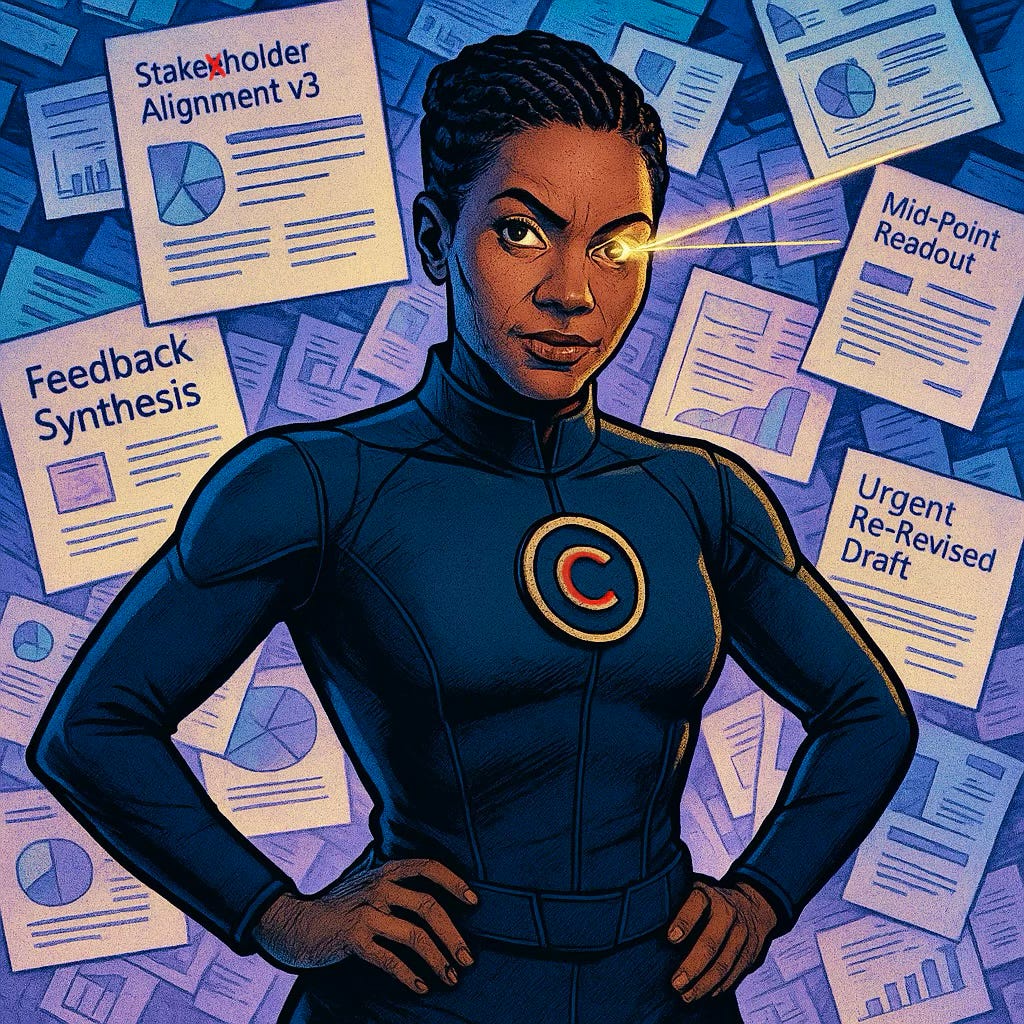
By week eight, there were nine decks in circulation and David wanted a mid-point readout deck, and that’s when Miranda’s left eye began to glow softly, like a notification light no one had been paying attention to.
“We should probably do a mid-point readout,” David said.
“No,” Miranda said quietly.
“Sorry?”
“We should probably not do a mid-point readout.” Her voice had changed. Deeper. The voice of someone who had just unsubscribed from every project Slack channel and felt no remorse.
“Well, we just think it would be helpful to—”
Miranda felt something ancient awaken inside her. A knowing. A power passed down through generations of consultants who had seen this pattern before.
Not this time.
Miranda unmuted herself deliberately. In the Zoom call, this was more threatening than it should have been, but somehow everyone felt it. Three people reached to check if they were still muted.
“Here’s what’s helpful, David. I’m going to deliver the actual deliverable now. The one you hired me for. The answer to your question.”
She shared her screen. One slide. “BUY THE THING” in 140-point font.
“But we need to understand the rationale!”
Slide two: “BECAUSE IT’S CHEAPER AND FASTER AND YOU DON’T HAVE THE INTERNAL CAPABILITY”
“What about the stakeholder concerns—”
Slide three. “THE STAKEHOLDERS WILL SURVIVE”
David’s face had gone pale on his webcam. “Miranda, we really need more supporting documentation—”
She closed the deck. Opened a new one. Titled it “SUPPORTING DOCUMENTATION.”
“NO… YOU… DON’T”
Someone’s Slack status changed to “away.” Another person’s video feed cut out, but everyone knew it was intentional. The silence stretched. Someone’s cat walked across their keyboard. No one laughed.
“I’m sending you three vendor contacts,” Miranda said. Her eye had stopped glowing but the power remained.
“You will call one of them by Friday.
You will make a decision.
You will not create an evaluation matrix.
You will not form a committee.
You will not ask ChatGPT to generate selection criteria.
You will pick up the phone, say ‘we’d like to buy the thing,’ and then you will send me my final payment as specified in the contract, which ended four weeks ago.”
“But—”
“David.” She leaned toward the camera. Behind her, the virtual background flickered—was that fire? Had she changed it mid-call? No one was sure.
“I have deleted all eighteen decks from the shared drive. They’re gone.
The Stakeholder Alignment deck? Gone.
The Feedback Synthesis v2? Erased from existence.
The deck about which decks to read in what order? I have removed it from all backups and emptied the trash.”
“You can’t just—”
“I kept one.” She held up her phone, showing a single file in her downloads folder. “The answer. Five slides. It’s all you need. I’m emailing it to you after this call. If you create any additional decks, if you screenshot these slides and put them into a new deck, if you ask an AI to ‘expand on this with more detail,’ I will know. And I will come back.”
She didn’t say what would happen if she came back. She didn’t need to.
They bought the thing on Thursday. Vendor B. They made the decision in a fifteen-minute phone call.
Miranda got her final payment plus a “consulting efficiency bonus” that David’s assistant said was “for helping us streamline our decision-making process.”
She framed the email.
Last anyone heard, Miranda now works exclusively with companies that have been deck-cursed. She shows up. Deletes everything. Delivers one perfect slide. Leaves.
They call her The Consolidator.